Welcome to the Institute for Regional Science
Learn more about our work in urban and regional research, through which the IfR actively participates in shaping equitable cities, regions and urban futures.

The brochure ‘Who owns Connewitz?’ by Marius Strohdiek (University of Leipzig), Dennis Hof (BBSR/IfR) and Michael Janoschka (IfR) presents the findings of a three-year research project on the Connewitz district of Leipzig in a form accessible to a general audience. Based on a household survey, qualitative interviews, mapping exercises and workshops, it examines opaque ownership structures, trends in rents and service charges, renovation and new-build projects; and how residents experience all of this. The leaflet will be published shortly in a print run of 10,000 copies, distributed to households in the neighbourhood and presented on 6 October as part of a panel discussion at UT Connewitz. In addition, the brochure is available as a downloadable version.
Learn more
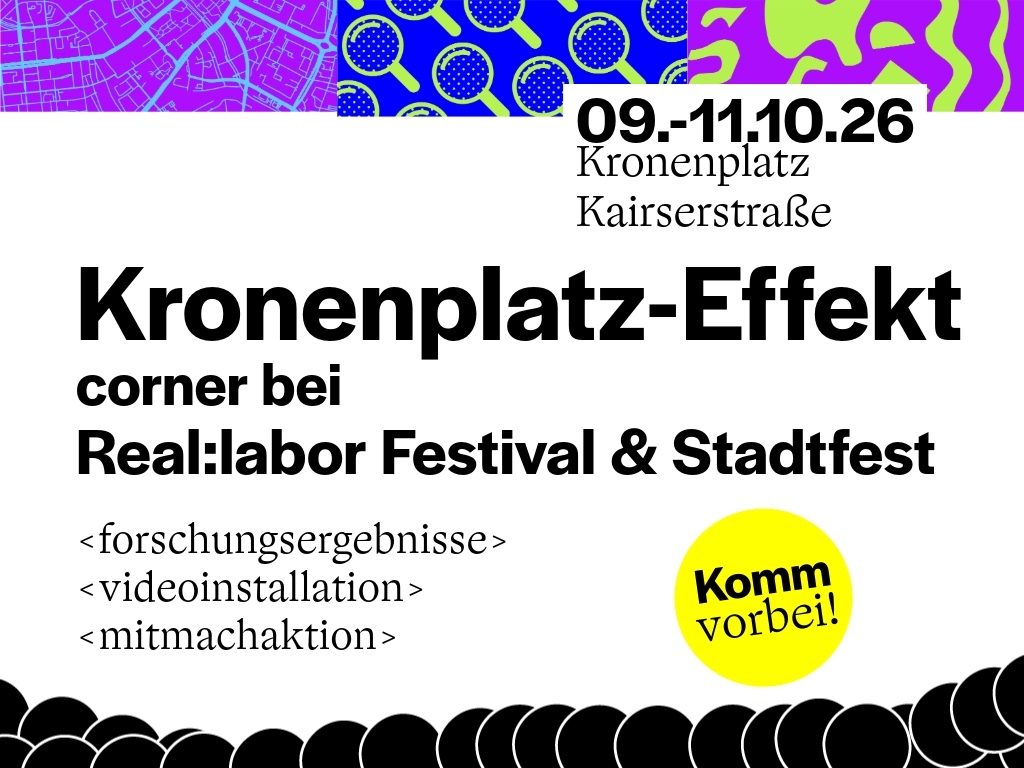
From 9 to 11 October 2026, our knowledge transfer initiative ‘corner <Science> to meet you!’ will be back at Kronenplatz. The event coincides with the opening of ‘KIT spark’ on 9 October and the Karlsruhe City Festival from 10 to 11 October. The event will feature insights into the latest findings from the 'Kronenplatz Effect' research project, the video installation 'Hot, hotter, city – We measure what you feel', and a range of hands-on activities. As a stop on the Real:labor rally, we at corner invite visitors to discover the hidden infrastructure and processes that keep our city running on a day-to-day basis.
📍 Kronenplatz, Karlsruhe
📅 9–11 October 2026
🕒 Fri 3.00 pm–7.00 pm, Sat 12.30 pm–6.00 pm, Sun 10.00 am–4.00 pm
Come along, join in and discuss with us about science, the city and society!

Temporarily repurposing parking spaces on Wilhelmstraße in the Südstadt to test just how liveable public space can be – that’s what our ra:ve project team set out to do. The ‘Raum für Veränderung’ (Space for Change) project took part in Park(ing) Day 2026, the international day of action on which street space is temporarily transformed into green oases with seating areas or playgrounds.
On this day, the ra:ve team transformed the car park in front of the project space into an open-air living room using tables, deckchairs and rugs, creating a space for dialogue, creativity and knowledge-sharing. The aim was to create a space where, in a relaxed atmosphere, a co-creative exchange could take place on the subject of the Südstadt research area:
🧱 To improve accessibility to our space, we worked together to build a ramp out of Lego
🔎 As part of our research, we spoke to lots of residents about the neighbourhood and what it’s like to live in Südstadt
🥗 The evening in the car park then drew to a close with a cosy dinner together.
We would like to thank all the visitors and participants who made Park(ing) Day 2026 possible for this lovely day.
Find out more
From 23 to 26 July, corner <Science> to meet you! was a guest at DAS FEST in Karlsruhe. Under the slogan ‘Hot, hotter, city – We measure what you feel’, corner brought the latest research on the urban climate and heat to life for festival-goers. The starting point was the Kronenplatz Effect research and intervention project. This project examines how highly heated public spaces can be transformed through temporary shading, greenery, and other cooling elements, and how these measures are perceived and utilized by local residents. An exhibition, an interactive video installation, and a thermal imaging camera illustrated how urban heat is generated, how it can be measured, and what role materials, urban planning, environmental conditions, and our everyday behavior play in this process.
Read the report

Larissa Brandenstein and Carolin Seiberlich, both doctoral candidates and research associates at the IfR, had the excellent opportunity to present their current research at the World Planning Schools Congress, which took place at Aalto University in Helsinki, entitled PERIPHERAL VISIONS - RETHINKING PLANNING. Carolin Seiberlich, an urban planner and researcher, presented her research in the special session on the energy transition in municipalities. Her research investigates enabling and hindering factors which occur during post-fossil transformations of the housing stock. She gave a presentation on the social phenomenon of energy poverty and its relation to energy efficiency driven retrofits. Larissa Brandenstein participated in the panel on Practices and Actors, presenting her research on the role of planner’s motivation shaping disaster risk reduction in Chile. Besides, she joined the roundtable “Planning for Whom or for What? The Uncomfortable Truth About 21st Century Motivations”.
Discover more
We are delighted that our graduate, Nicole Andrea Pernice, has been awarded the prestigious ARCADIS Award for Geo and Environmental Research 2026 for her Master’s thesis entitled 'Governance in Water Management in Cochabamba – An Analysis from the Perspective of Political Ecology'. This award recognises outstanding Master’s theses and doctoral dissertations completed at KIT institutes specialising in geo and environmental sciences. Entries for the prize should focus on the protection and sustainable management of soil and groundwater as georesources. In her work, Ms Pernice demonstrated impressively that technical solutions in water management should not be considered in isolation from the relevant social context. As a civil engineer and regional scientist, Ms Pernice generated new insights by thinking beyond disciplinary boundaries and demonstrating that the power dynamics she reconstructed have a significant influence on the water supply in her home town of Cochabamba, Bolivia. The award ceremony took place as part of the BGU Faculty’s graduation ceremony on 4 July. Congratulations!
More about ARCADIS Award
On 26 June 2026, during the Transformation Talks 4.0 in Essen, Germany, IfR research associate Anna-Barbara Grebhahn held a talk on 'New perspectives through real-world experiments — urban intervention for a culture of experimentation'. Her presentation provided an insight into the real-world laboratory research project 'ra:ve – Space for change' in the Südstadt district of Karlsruhe as well as into the real-world laboratory experiments at Werderplatz. Starting on 8 July 2026, the experiments will be carried out by IfR Master’s students in Regional Science/Spatial Planning as part of their research activities. 'Participating in the Transformation Talks 4.0 was an enriching experience', says Anna-Barbara Grebhahn: 'In addition to fascinating presentations and stimulating discussions at the World Café, we also gained insights into neighborhood projects run by the "Be-MoVe" real-world lab during an excursion and took a guided tour of St. Gertrud Church, which is part of "Manifesta 16 Ruhr". Many thanks to all the organizers for their hospitality and their curiosity about transformation processes at the intersection of art, the city, and science.'
Learn more
The article 'Money, meaning, and territory: family business groups and agro-extractive systems in Latin America', published in the journal Extractive Industries and Society by Maria-Dorothea Wolf (IfR), David Kornbluth Camblor (UCHILE), Manuel Bayón Jiménez (COLMEX), Michael Lukas (UCHILE) and Michael Janoschka (IfR), examines how family business groups connect and coordinate fragmented relationships within Latin America’s agro-extractive systems. Based on a comparative analysis of the Maggi (Brazil), Angelini (Chile) and González Hank (Mexico) business groups, the study shows that family business groups perform comparable coordination functions despite their differing organisational positions. Their significance lies less in their ownership of individual companies or infrastructure than in their ability to link material, institutional and symbolic relationships across territories and organisational boundaries. The article thus expands research on agro-extractivism by offering a new perspective on the coordinating role of family business groups.
Read the article

On 12 June, we gathered for the soft opening of our 'ra:ve – Raum für Veränderung' (ra:ve - space for change) project space in the Karlsruhe district of Südstadt. The inauguration of this venue marks a significant milestone in the teaching and real-world laboratory project, as we, as researchers, are now putting down deeper roots in the Südstadt district of Karlsruhe so that we can actively engage with the neighbourhood. Through ra:ve, we aim to collectively reimagine the Südstadt, exchange ideas and engage in dialogue with one another. We look forward to welcoming neighbours, community members, stakeholders and real-world lab researchers soon at Wilhelmstraße 16 during our opening hours! The IfR has been actively conducting urban research in the Südstadt district since 2022 and, as part of the courses 'Project seminar: transformative research in the neighbourhood', 'Sensing space: exploration and analysis of urban space' and 'Tools for urban research', trains the next generation of urban researchers on the Regional Science/Spatial Planning Master’s degree programme. The ra:ve project space is a new teaching and learning venue for students and the local community. With building number 01.89, the space is an official part of the Karlsruhe Institute of Technology.
More about ra:ve
More reports on our activities, publications, teaching and real lab projects over the past few months and years: enjoy browsing the IfR blog!
Browse the IfR blog